Action Blast: September 16, 2026
💥 TAKE ACTION TODAY 💥
💧 One Week to River Run! 💧
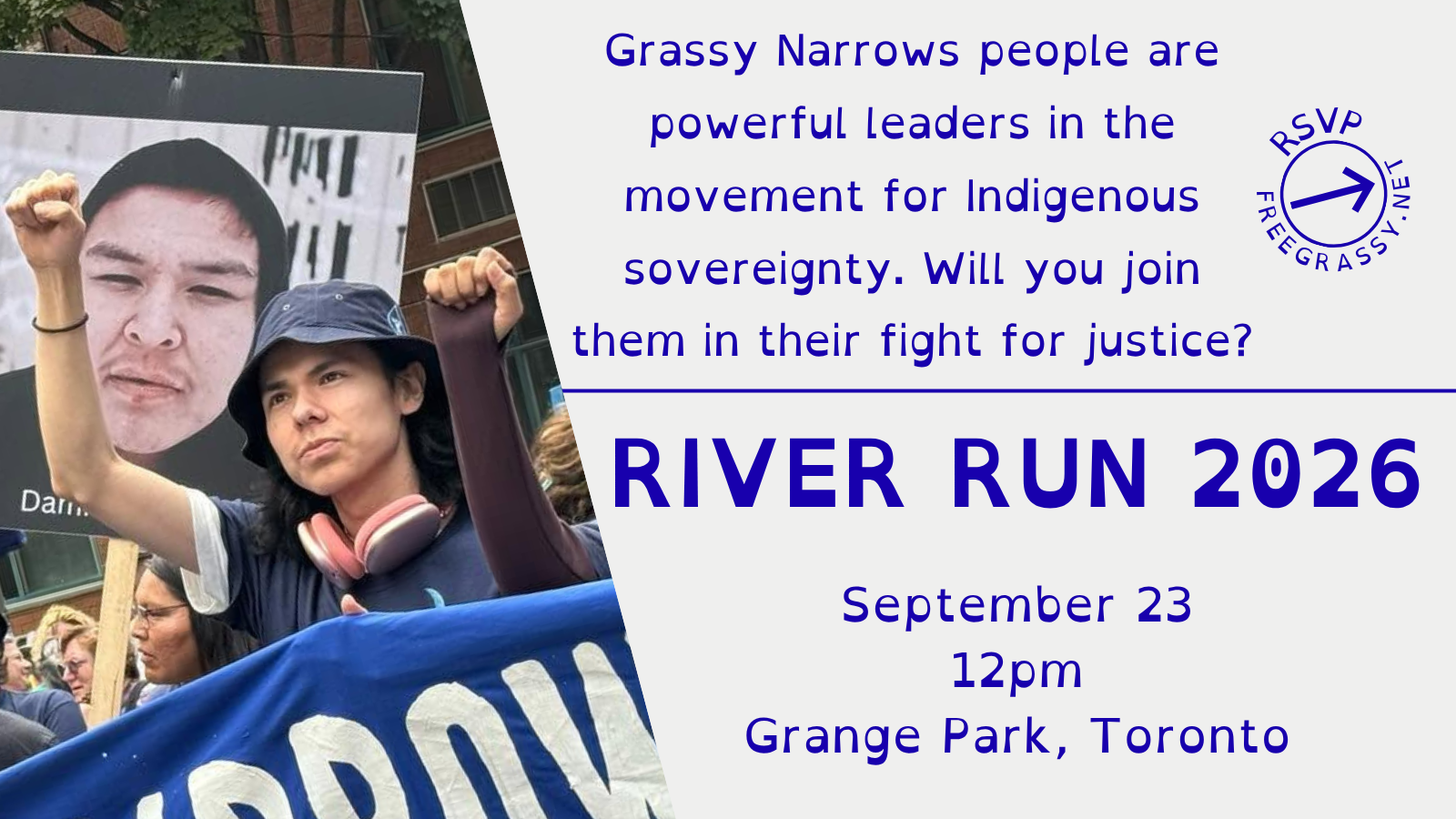
We are officially ONE WEEK AWAY from River Run 2026! Join us at Grange Park at 12pm on September 23!
We’re doing our best to make River Run as accessible as we can — check out the River Run Access Guide for full details!
Can’t make it to River Run in person? Check out the livestream and other ways to support Grassy Narrows no matter where you are!
There are upcoming events to prepare for and promote River Run, we’d love for you to join us:
Join us for postering! Sign up to help us make River Run impossible to ignore!
September 17 at 7pm - Moss Park
September 18 at 5pm - City Hall
September 20 at 6pm - College and University
September 21 at 8pm - Bay and Wellesley
September 19 from 1-4pm: Come make art for River Run that sends Grassy’s message loud and clear!
September 21 at 8pm: An evening of wheatpasting (postering) to spread the word about River Run!
Get creative! Check out this amazing resource for making your own sign for River Run, with stencils, slogans, and other suggestions. Show off your sign on social media — don’t forget to tag @surj_toronto, @decolonialsolidarity, and @grassy.narrows.solidarity and use #FreeGrassy and #RiverRun2026!
Not in Toronto? There are buses coming to River Run from Guelph, Kingston, Hamilton, Kitchener/Waterloo, Peterborough, London, and Barrie/Orillia. Find a bus near you!
It takes hundreds of volunteers to make River Run happen. If you have the capacity to lend a hand, we'd love your support!
📢 March for Migrant Justice 📢
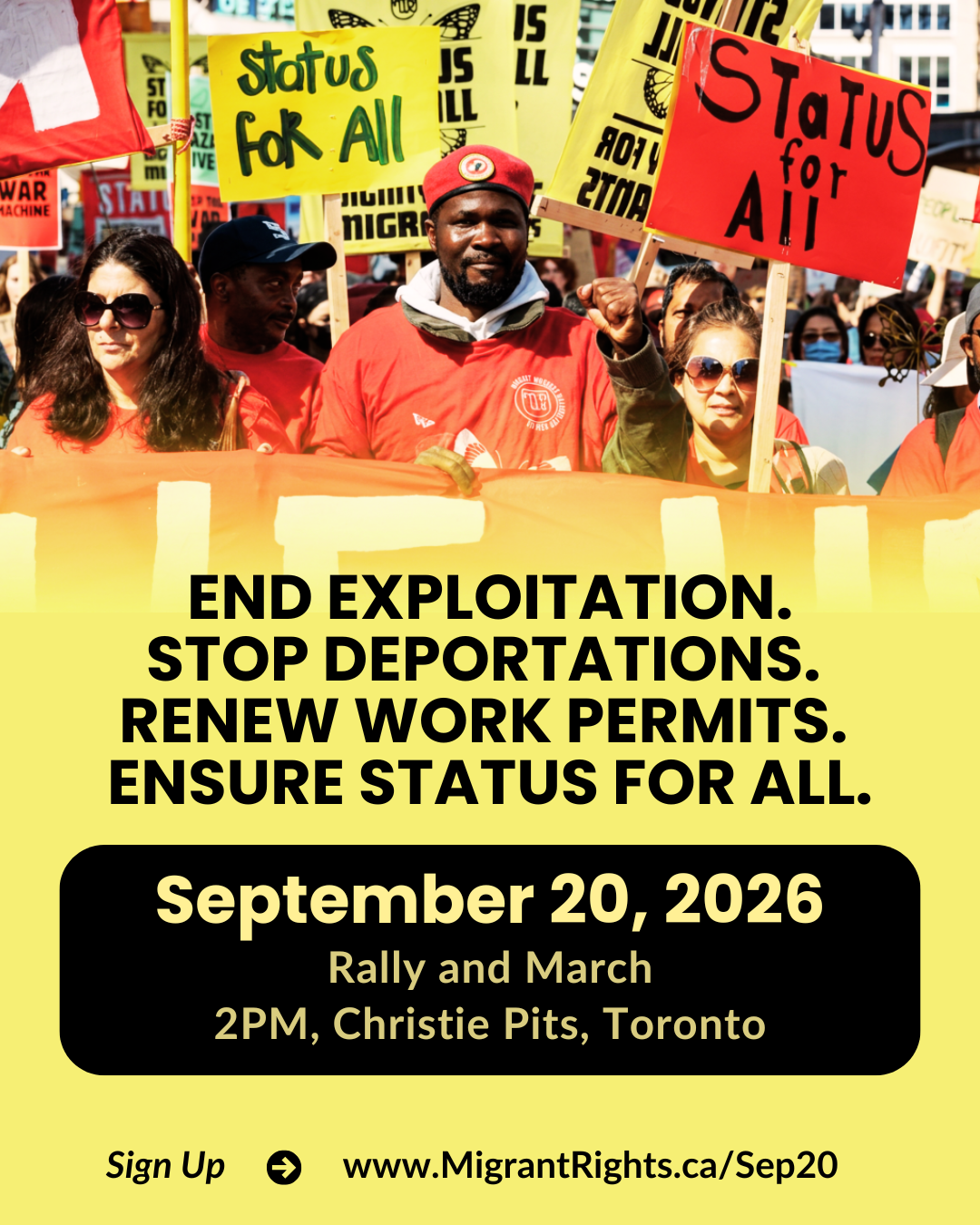
On September 20, migrants and allies will take to the streets in Toronto as part of the 5th Annual Cross-Country Day of Action for Migrant Justice.
Migrants make Canada work. They care for children and elders, grow food, build homes and keep communities running. But the government is pushing migrants out. Millions of permits are expiring or being refused, deportations are increasing and refugees are under attack.
Join us as we march for equal rights, permanent resident status for all and a future where no one is exploited or deported because of where they were born.
📅 Sunday, September 20
⏰ 2:00pm
📍 Christie Pits Park, Toronto
International students from Portage College were already protesting unfair changes to the rules affecting their post-graduation work permits. In mid-July they set up a round-the-clock protest. On August 12, Calgary Police called the Canada Border Services Agency (CBSA) to it. Ten protesters were issued removal orders that same day. Sign the petition to demand justice instead of immigration enforcement, and donate to support the students,
Know your rights! Learn more about Immigration Arrest, Detention, and Deportation, and Your Rights at Protests.
📚 More Actions and Resources 💻
This is where we link to external content we found interesting, challenging, or thought-provoking this month. Our movements are stronger when we listen to, learn from, and collaborate with folks whose perspectives and approaches are different from ours. Inclusion here does not imply endorsement.
Act:
In October 2016, a tugboat ran aground off the coast of British Columbia and spilled over 110,000 litres of diesel oil in Haíɫzaqv (Heiltsuk) Nation’s waters. Now, nearly ten years later, the Nation still hasn’t been fully compensated by the federal government for the harms they have suffered to their food systems, economy, and way of life, and they continue to seek justice in the courts. Sign the pledge to show solidarity with the legal action Haíɫzaqv Nation is taking to protect not just their coastline, but coastal ecosystems across Canada.
Canada is still enforcing policies designed to assimilate First Nations, imposing a colonial framework under which the legislated extinction date for every First Nations band in Canada can be calculated. The government’s control over who is considered a “status Indian” is far from symbolic. Status determines access to community, culture, treaty rights, programs, and political recognition. Nationally, 29% of status Indians are at risk of losing the ability to pass on their status. That means that, unless they choose to parent with another status Indian, their children will not have status. Over generations, this rule threatens to legally erase First Nations altogether. This forces people to choose between loving who they love and protecting the legal identity of their children - a choice no one should have to make. Send a letter today and demand an end to sex- and race-based discrimination in Indian status registration; end the second generation cut-off!
Redistribute funds to Indigenous organizations doing critical work, both in our city and throughout Turtle Island. There are too many to list in one place, but if you’re looking for a place to get started, here are a few options:
Attend:
September 16:
Together for Nature - musical performance, keynote addresses, film screening
Indigenous Voices Matter: A National Town Hall on Childhood Sexual Abuse
September 18
Beyond the Smoke: Fighting the Flames of Climate Change - speakers & film screening
September 19
Medic Preparedness - first aid training (virtual)
Resistance & Reconciliation in York - walking tour
Palestinian Land Exercise - interactive workshop
Cut Ties with Genocide, Stand with Sudan - webinar
September 21
September 21 - 25
National Centre for Truth and Reconciliation Lunch and Learns - webinar series
September 22
September 22 - 29
Orange Shirt Day events for youth at Toronto Public Library - storytime, crafting
September 23
Urban Indigenous Proud - film screening
Say No to AI Data Centres - virtual town hall
September 29
Trick or Treaty? - film screening
September 30
The Right to Truth: Protecting Indian Residential School Records - panel discussion
Eden Robinson - The Sorceress of Sky Serpents - book launch
September 30 - October 9
🧡 September 30 is National Day for Truth and Reconciliation 🧡
Read:
In 2015, the Truth and Reconciliation Commission of Canada released 94 Calls to Action, an appeal to mobilize all levels of government, organizations, as well as individuals to make concrete changes in society. They list specific actions to redress the legacy of residential schools and advance the process of Canadian reconciliation. Check out Spirit Bear’s Guide to the TRC Calls to Action for youth!
The National Centre for Truth and Reconciliation (NCTR) raises awareness of the history and creation of the residential school system, its ongoing legacy, and how it has shaped the country we live in today. Their resource collection includes hundreds of downloadable apps, books, computer games, films, graphic novels, lesson plans, teaching guides, and more related to residential schools and other closely related topics.
Putting truth and respect before reconciliation: How a recent editorial from Canada’s paper of record creates space for residential school denialism to take root.
Indigenous survivors of Canada’s residential schools tell the stories of those who never made it out: Canada’s ‘crying shame’: The fields full of children’s bones.
Watch:
In The Knowing, journalist Tanya Talaga and her family’s eight-decade long search for family matriarch Annie Carpenter, reveals a story deeply intertwined with Canada’s Indian residential school system.
Check out the full CBC collection on National Day for Truth & Reconciliation to hear the stories of Indigenous voices through specials, documentaries, and films.
Community Perspectives of UNDRIP: Speakers Marilyn Buffalo and Megan Lewis discuss the journey of Canada’s endorsement of the UN Declaration on the Rights of Indigenous Peoples, the significance of this milestone, and its potential to reshape the Crown-Indigenous relationship.
Confronting Residential School Denialism, one of the largest identified barriers to reconciliation. Dr. Niigaanwewidam Sinclair and Residential School Survivor Eugene Arcand dismantle the most frequent and inaccurate denialist arguments in a conversation moderated by Dr. Sean Carleton.
The Orange Shirt society shares videos on residential school history, reconciliation, and truth and healing.
Listen:
Unlearning the Colonial Lies, Reclaiming the Knowing with Tanya Talaga: Dr. Candace Manitopyes sits with award-winning journalist, author, and filmmaker Tanya Talaga, whose work has become a lifeline for truth in a country still wrestling with denial. From the moment they begin, the conversation feels less like an interview and more like two Indigenous women pulling back the curtain on generations of silence, survival, and spiritual return.
So much of what we know about Canada's residential schools has been established as fact. More than 150 000 Indigenous children and youth were taken from their families and required to attend these schools. Several thousand students died. Although all of this is well-documented and verified, there has been a growing discourse calling those facts into question. What’s fuelling residential school denialism?
94 calls – but who’s answering? Jolene Ashini is – she is the first lawyer to emerge from her community and is determined to change the system from the inside. And Senator Pate is giving voice to 12 Indigenous women who have been silenced by the system. Rosanna Deerchild speaks with two women responding to the 94 Calls to Action in the area of justice.
Kuper Island is an 8-part podcast series that tells the stories of four students: three who survived and one who didn’t. They attended one of Canada’s most notorious residential schools – where unsolved deaths, abuse, and lies haunt the community and the survivors to this day.